Striving For The Infinite in Goethe's Faust
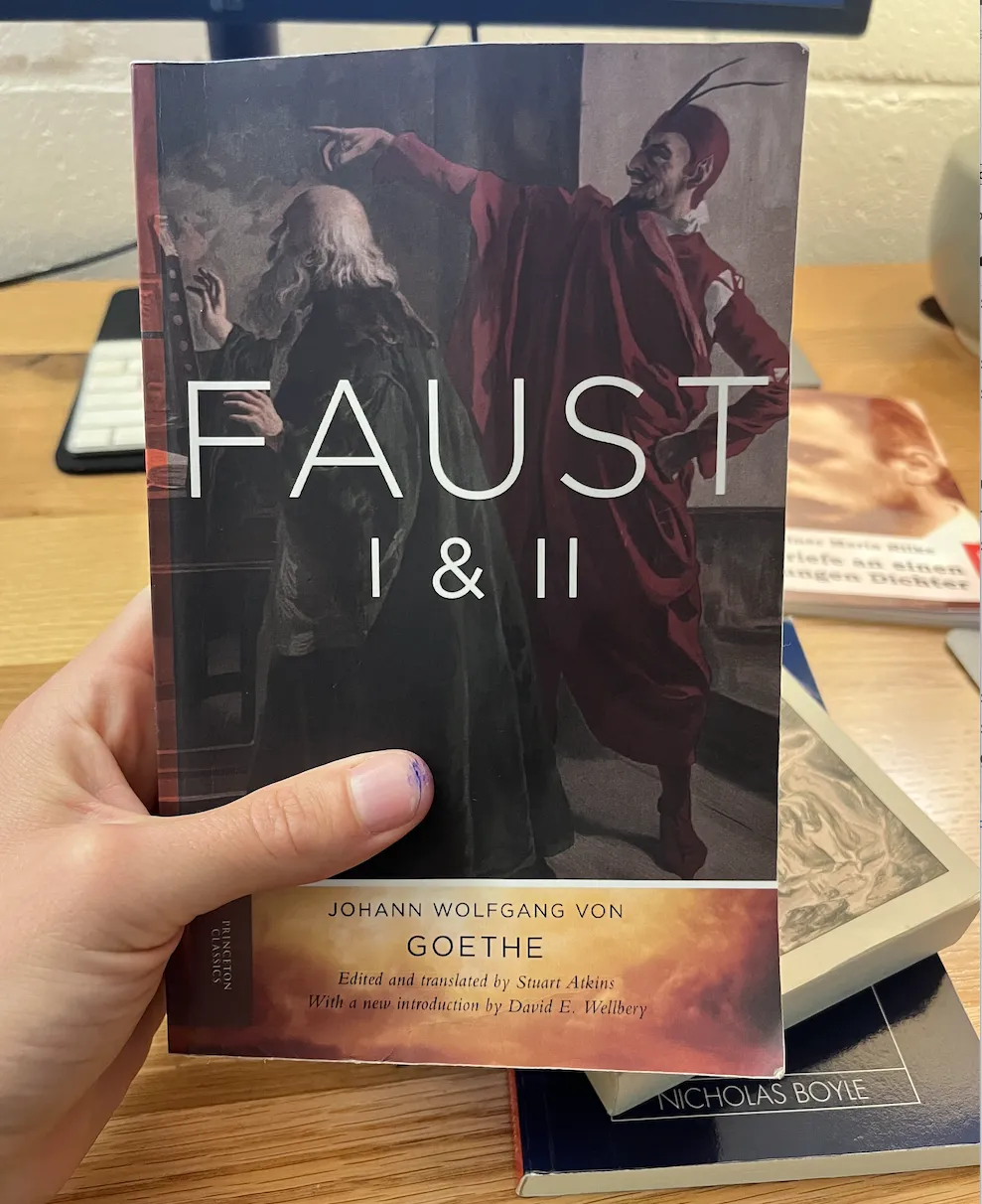 I’ve come to pick (or be picked by) the moment when Faust grapples with his feelings for Gretchen. This single scene touches both on striving for the infinite, Faust’s ultimate ambition, as well as the nature of the wager, which Faust comes dangerously close to losing in this very moment.
Faust’s lines come at the end of the scene in which Mephistopheles tries to convince Faust to lie about having seen Martha’s dead husband in order to get another chance to see Gretchen. At the end of this scene, Mephistopheles challenges the truthfulness of Faust’s swearing love to Gretchen. Faust justifies himself, saying the following:
Faust – Line 3059
Stop there! It will! – When I am deeply moved
And for turbulence I feel.
Vainly endeavor to find a name,
Yet range the world with all my senses
And search for words sublime enough
And call this ardor that consumed me
Infinite, endless, and eternal
Is that some diabolical delusion?
This seeming mistranslation by Atkins gives us a great launching off point to talk about the nature of the infinite, a central element in the whole poem.
In the original German, the following line “Infinite, endless, and eternal” only uses two adjectives instead of three. The same line in German reads, "Unendlich, ewig, ewig nenne”. “Unendlich” correctly translates to infinite; and “ewig” translates to eternal. However, there’s no mention of endless, as in Atkins’ English translation. Why does that matter? Well, because it could be argued that endlessness is exactly what Faust is not striving for, and it’s also not the nature of his experience here with Gretchen.
Endlessness is more akin to Hegel’s bad infinite, a mindless and purposeless repetition of the same finite. True infinity, on the other hand, is substantially different from the finite, and not just a mere endless extension of it. When endlessness is a line that never ends, true infinity is more akin to a circle. Endlessness is a row of never-ending numbers; it's n+1. The infinite, however, is an entity in itself, with its own particular characteristics, and is distinct from anything finite (the Latin prefix “in-” meaning “not”).
This true infinity is what Faust was striving for all along, line 1815: “I’m not nearer to the infinite”.
So, all this made me wrestle with the question: what does it even mean to strive for the infinite?
Finding the Infinite in the Finite
The “finite” refers to the earthly world, as in all the things you can touch and feel and see. This means money/gold, physical goods, food, etc. – as Faust lists here:
Faust - Line 1675
And what have you to give, poor devil?
Has any human spirit and its aspirations
ever been understood by such as you?
Of course you’ve food that cannot satisfy,
gold that, when held, will liquefy
quicksilver-like as it turns red,
But the finite can also be less tangible, and certain experiences fall under it. Faust continues:
Games at which none can ever win,
a girl who, even in my arms, will with her eyes
pledge her affections to another,
the godlike satisfaction of great honor
that, like a meteor, is gone at once.
Show me the fruit that, still unplucked, will rot
and trees that leaf each day anew!
Based on Faust’s description, they’re finite in the most literal sense as they all expire. Even before ever fully coming to fruition, they never come to full “form”.
The infinite, on the other hand, is the forms that last, and last forever. It’s beauty, and truth, and courage, and love. For Plato, these forms were in a “place beyond heaven".
However, such forms can express themselves for a moment in the finite world. And when they express themselves, they become visible for a moment. The infinite is an ideal, and in itself a complete form, and occasionally we get to glimpse a reflection of this ideal in the finite world.
Here’s Faust giving two examples - Line 1573:
Happy the victor on whose brow
Death binds the blood-flecked wreath of laurel!
And happy he who, after the mad dance,
is found by Death in love’s embrace!
Other examples are, two lovers looking at each other and, in that moment, having a glimpse of the infinite. It’s someone standing up and speaking the truth when it’s inconvenient. Or, it’s an artist playing a perfect piece. These are all moments where the forms briefly temporalize themselves in the finite world.
Returning to our opening lines, Faust gets to experience exactly this, in his love for Gretchen.
Faust - Line 3064
And search for words sublime enough
And call this ardor that consumed me
Infinite, endless, and eternal
And it’s this experience with Gretchen, that he not only glimpses the infinite in the finite, but he also almost loses the wager.
Almost Losing the Wager
Now, let’s look at the wager itself. The more I read it and re-read it, the more opaque it became.
Firstly, there are two almost independent elements to the bet.
The initial version of the bet:
Faust - Line 1692:
If on a bed of sloth I ever lie contented,
may I be done for then and there!
If ever you, with lies and flattery,
can lull me into self-complacency
or dupe me with a life of pleasure,
may that day be the last for me!
This is my wager!
This seems rather straightforward. Faust says, all the earthly delights that Mephistopheles can offer him will never appeal to him, and Mephistopheles won’t be able to “dupe” him with pure pleasure.
This bet makes sense to Mephistopheles, and he agrees to it, believing that eventually Faust will succumb (Line 1855, Mephistopheles: “And it’s dead certain you’ll be mine!”).
However, while Mephistopheles understands the bet by agreeing to it, he also shows his ignorance and lack of understanding of Faust. As Faust already said beforehand (Line 1676, Faust: “Has any human spirit and its aspirations, ever been understood by such as you?”). This lack of understanding on Mephistopheles’s part is then cemented even more shortly after by taking Faust to Auerbach's cellar, which has no appeal to Faust.
However, after the terms of the bet are agreed on and they shake hands, Faust follows up with another bet, which seems rather different in sentiment.
Faust - Line 1699
If I should ever say to any moment:
Tarry, remain! – you are so fair!
Then you may lay your fetters on me,
then I will gladly be destroyed.
While the first part of the bet is a bet against the devil, betting that he can’t seduce Faust with earthly pleasure, this second version seems like a bet against the world Faust lives in. Having not gotten any nearer to the “infinite”, and almost committed suicide as a last-ditch effort, this bet reveals Faust’s view that there’s nothing worthwhile in the world, and thus he will never say “stay moment, you are so fair”.
Importantly, this isn’t about his inability to “be content” or “be happy in the moment”; instead, it’s a reflection of Faust’s disillusionment and his presumed inability to get ever nearer to the Forms, the infinite.
Faust has to strive. He wants to experience it all. But he’s also given up hope that it will get him any closer to the infinite, hence he offers up the bet.
Now, despite all the details about putting the bet to paper and signing it with blood, we actually don’t know what was actually put to paper. Regardless of which of the two it was, Faust came close to losing both versions of the bet. And the reasons why he didn’t lose the bet both reveal something about the Faustian man as well as the devil.
Almost Lost Bet 1: Content on the Bed of Sloth
Briefly after his love liaison with Gretchen, Faust says the following when Mephistopheles tries to get him on to new adventures (line 3252).
Mephistopheles:
Will it be long before you’ve had enough of this?
How can this life continue to amuse you?
No doubt it’s good to try it once;
but then go on again to something else!
Faust:
I wish you’d other things to do
than plague me when I am content without you.
Now, in this moment, Mephistopheles could “catch” Faust. Simply based on his lackluster striving, since, as a sort of addendum to the contract with Mephistopheles, Faust promised to strive completely:
Faust - Line 1741
You need not fear that I will break this contract!
It is to strive with all my might
that I am promising to do.
Yet, strangely, it is Mephistopheles who pushes him forward. He’s the one that fans Faust’s striving:
Faust – Line 3247
Untiringly he fans within my breast
a burning passion for her loveliness.
I reel between desire and enjoyment,
and in enjoyment languish for desire.
So, the Lord's prediction was right: “human activity slackens all too easily, and people are soon to rest on any terms; that’s why I like to give them the companion, who functions as a prod and does his job as devil” (Line 340).
Now, secondly, why doesn’t Faust’s proclamation that he’s “content” make him lose the bet? Well, the bet was if Mephistopheles can dupe him with earthly pleasure to be content. However, Faust’s love here is real, and it isn’t flattery or cunning that gets him to enjoy it.
Also, even though he might be “content” right now, he’s far from "lying on a bed of sloth”; instead he “reels between desire and enjoyment, and in enjoyment languishes for desire.”
Almost Lost Bet 2: Tarry, remain! – you are so fair!
Faust also almost loses the second version of the bet.
Faust to Gretchen, Line 3190:
Express what tongue can never say:
complete devotion and a sense of bliss
that must endure eternally!
Eternally! – Its end would be despair.
There must not be an end! Not ever!
“There must not be an end! Not ever!” Well, that’s quite close to “If I should ever say to any moment: Tarry, remain! – you are so fair!”. At least it could be argued that the meaning is quite the same.
So, why doesn’t he lose the bet?
Now, at this moment two things happen all at once.
Firstly, Faust is proven wrong in this very moment.
The second part of the bet was against the nature of the world, and Faust assuming that there’s nothing valuable in it. Nothing valuable enough that would ever make him want a moment to last.
However, in his love for Gretchen, he realizes there’s something worthwhile (infinitely so, as he wants it to continue eternally). (Nicholas Boyle would agree, saying: “Faust, who denied that the world contains any finite good, has found instead an infinite good.”)
He’s just lucky in that moment that Mephistopheles can’t comprehend this – as Mephistopheles himself sees nothing of value in the world.
Mephistopheles, Line 1338
I am the spirit of Eternal Negation,
and rightly so, since all that gains existence
is only fit to be destroyed; that’s why
it would be best if nothing ever got created.
But Faust isn’t only proven wrong once, but twice. The bet implied that if he would encounter a moment that’s worth saying “Tarry, remain! – you are so fair!” to, it would signal the end of his striving. Yet, it doesn’t. Despite him having found something valuable, he continues to strive.
So, while he doesn't lose the bet, he’s still proven wrong about his view of the world (there’s something infinitely valuable in it, thus he’s “negated”) and about the nature of his own striving (it’s ceaseless, driven by negation).
Striving of The Modern Man
This captures something about both the world and the Faustian man. The Faustian man can encounter the infinite in the finite world, and thus there’s something of value in it. And it will still not lead to the end of striving, since it’s in the nature of the Faustian man to strive ceaselessly.
So, one wonders, if the tragedy could have been averted if Faust could actually say “Tarry, remain! – you are so fair!”. But he can’t. And that’s why it’s a tragedy. The alternative to Gretchen’s misery isn't Faust learning to stop striving, but the alternative is that Faust isn’t Faust. Line 1710: “If I stagnate, I am a slave”.
And so, the moment when Faust goes back to Gretchen, is not the moment where the tragedy is unpreventable. Instead, it is the moment when Faust shakes hands with the devil, because it’s in this moment that his ceaseless striving is unleashed on the world. From that moment on the tragedy was destined to play out as it did.
It’s the striving that lets him glimpse the infinite, it changes the world, and it brings terror and beauty. That’s why facing nothingness, and facing the spirit of negation, can both lead to greatness and destruction.